Scale-Up Hiring Signals: A Recruiter's Vertical BD Guide
Hiring signals predict scale-up recruitment need 20-30 days early. Learn which signals matter by vertical and how to build a BD pipeline that wins first.

Hiring signals are the market events that tell a recruitment agency a company is about to need people, before any job posting appears. For agencies focused on scale-ups, reading those signals by vertical is the difference between being the first call a founder makes and being the fifth agency to respond to a live brief. The problem most agencies face is not a shortage of prospects; it is a shortage of timing. According to recent data from Tracker RMS, 23% of staffing agencies now identify finding new clients as their biggest hurdle, up 7 percentage points year-on-year. The agencies closing that gap are not working harder on cold outreach; they are reading hiring signals earlier and acting inside the predictive window.
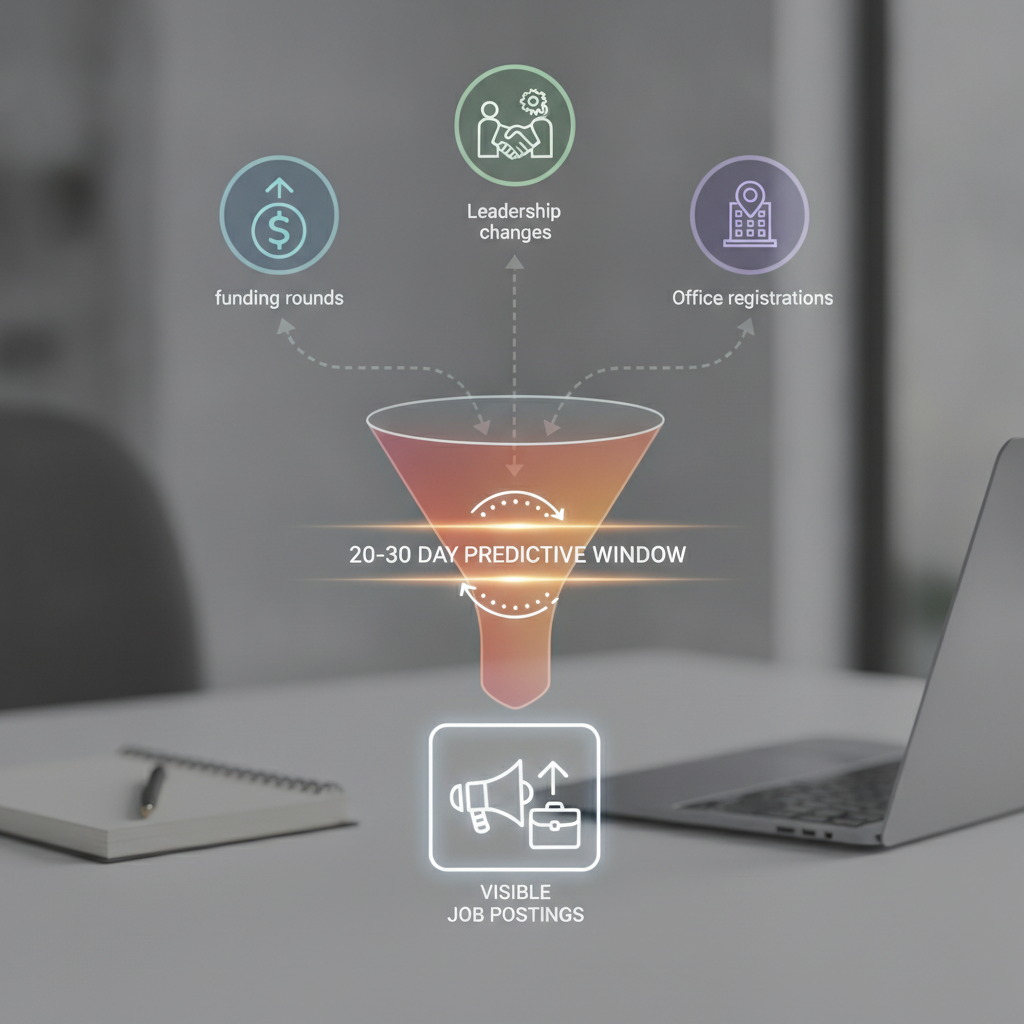
Why Scale-Ups Produce the Strongest Hiring Signals
A scale-up is a company that has validated its model and is deploying capital to grow headcount, revenue, and infrastructure simultaneously. That combination produces highly readable hiring signals because the growth triggers are structural and documented. A funding round is filed. A leadership hire is announced. A new office is registered. Each event connects directly to a predictable surge in recruitment need, and most of those events are publicly visible 20 to 30 days before any job posting appears.
The scale-up segment is also growing fast. According to Mordor Intelligence's 2026 recruiting market report, small and medium-sized enterprises represent the quickest-growing client segment for recruitment agencies, at an 8.49% CAGR through 2031. That growth is concentrated in exactly the verticals where scale-ups cluster: IT and telecom, which already account for 29.15% of recruiting market share, and healthcare and life sciences, forecast to expand at a 9.04% CAGR between 2026 and 2031. Agencies that map their business development (BD) activity to vertical-specific hiring signals are positioned to capture a disproportionate share of that demand.
The challenge is that hiring signals differ sharply by sector. A funding announcement in SaaS carries different hiring implications than one in medtech. A leadership change at a fintech scale-up signals different roles than the same event at a professional services firm. Building a vertical BD guide means knowing which signals matter most in each sector, and what they typically predict.

Hiring Signals by Vertical: What to Watch and When
Hiring signals are AI-analysed market events, including funding rounds, headcount changes, leadership appointments, and technology adoption, that predict a company's future recruitment need before it surfaces as an open role. The signal type that matters most varies by vertical because growth patterns differ.
Technology and SaaS
In technology, funding signals are the most reliable predictor of near-term hiring. According to CRV's 2026 Series A metrics guide, Series A median round sizes ranged from roughly $5 million to $15 million in 2025, with median valuations climbing to $48 million at Series A in Q1 2025. The explicit purpose of Series A capital is to fund growing headcount and enter new customer segments. That means every confirmed Series A raise in your vertical is a near-certain signal that engineering, sales, and GTM roles are opening within the next 30 days.
Beyond funding, watch technology adoption signals. When a scale-up migrates to an enterprise-grade CRM, deploys a new data stack, or announces a product expansion, it typically needs to hire the people who can operate that infrastructure. These events appear in product forums, company blogs, and job board metadata before any formal vacancy is posted.
Healthcare and Life Sciences
Healthcare hiring signals are driven less by funding rounds and more by regulatory milestones, clinical trial phases, and site expansion announcements. A medtech company receiving regulatory clearance will hire commercial and clinical staff within a defined window. A life sciences firm announcing a new trial phase needs CROs, regulatory affairs professionals, and site coordinators. These milestones are public record and predictable in sequence.
The Bureau of Labour Statistics projects healthcare and social assistance will grow 8.4% through 2034, making it the fastest-growing employment sector. For recruitment agencies in this vertical, the BD opportunity is not just volume; it is timing. The agency that contacts a medtech scale-up the week after its clearance announcement, rather than the week its job postings go live, operates in a different competitive environment entirely. For a deeper look at how sector-specific signals differ, this breakdown of hiring signals across IT, finance and healthcare covers the structural differences in more detail.
Professional Services and Fintech
In professional services and fintech, leadership changes are the most consistent hiring signal. When a new CRO, CFO, or CPO joins a scale-up, the first 90 days almost always involve restructuring the team beneath them. New leaders bring their own hiring philosophies, often replace inherited vendors, and expand headcount to match their mandate. According to research covered in our analysis of leadership changes as hiring signals, this pattern is reliable enough to anchor a BD sequence.
Fintech scale-ups also produce strong regulatory compliance signals. Licence applications, FCA authorisations, and KvK filings in the Netherlands all indicate that a company is preparing to operate at a different scale, and that compliance, legal, and operational headcount will follow.

How Hiring Signals Change Your First Call
The practical value of reading hiring signals before a role is posted is that your first call is not cold. You already know the company's growth context, the likely roles they need, and the pressure the hiring manager is facing. That changes the conversation from a capability pitch to a genuine problem-solving discussion.
Predictive intelligence platforms like Recruit Signals surface these hiring signals and translate them into a Heat Score: a ranked list of companies most likely to need recruitment services in the next 20 to 30 days, built from concurrent signals across funding, leadership, headcount, and technology adoption. The practical result is that a BD consultant walking into a first call with a Series B SaaS scale-up already knows the funding context, the headcount trajectory, and the verticals where the company is most likely to hire. That preparation is not just a credibility advantage; it shortens the sales cycle because the conversation starts at the right level.
The contrast with reactive BD is significant. An agency responding to a live job posting is one of many. An agency that contacts the same company three weeks earlier, framing the conversation around the funding round and the growth stage, is talking to a decision-maker who has not yet been bombarded by competitors. As this analysis of the 20-day advantage sets out, the agency that arrives first sets the frame for every conversation that follows.
Building a Vertical BD Pipeline Around Hiring Signals
A vertical BD pipeline built on hiring signals looks different from a traditional pipeline. Instead of starting with a list of companies and working through it sequentially, you start with signal categories and work backwards to the companies they implicate. This approach keeps outreach contextually relevant and prioritised by urgency, not by alphabet.
The structural challenge for most boutique agencies is that this kind of monitoring is time-intensive when done manually. Over 70% of recruitment agencies never grow beyond a headcount of 10 people, according to Recruitment Entrepreneur's scale-up guide. For a 5 or 8-person agency, spending consultant time on signal monitoring rather than candidate delivery is a difficult trade-off. The agencies that solve this problem tend to either systematise signal tracking through a dedicated BD tool or assign a specific consultant to own BD intelligence as a function, not a side task.
A practical starting point is to define three to five signal categories that are most predictive in your vertical, then set up monitoring specifically for those. For a tech recruitment agency, that might be Series A and B announcements in your geography, CTO and VP Engineering appointment news, and product launch announcements from companies in your target size band. For a healthcare agency, it might be regulatory clearances, clinical trial phase completions, and hospital group restructuring announcements. The narrower and more vertical-specific your signal set, the more actionable your BD intelligence becomes. For agencies building this discipline from scratch, the BD playbook for a stabilising market covers the sequencing of signal-led outreach in more detail.
Messaging matters as much as timing. When you contact a scale-up in its predictive window, your outreach should reference the specific signal that triggered it. Mentioning the funding round, the new leadership appointment, or the regulatory milestone demonstrates that you understand their business context, not just their job titles. According to Recruiterflow's recruitment marketing analysis, agencies that built disciplined automations tied to real behavioural signals saw a 142% increase in job orders. The reason is exactly this: every message felt personal because it was anchored in something real about the recipient's situation.
Frequently Asked Questions
What are hiring signals and how do recruitment agencies use them?
Hiring signals are market events, such as funding rounds, leadership changes, headcount growth, and regulatory milestones, that indicate a company is likely to recruit in the near term. Recruitment agencies use them to identify prospective clients before roles are posted, so outreach arrives with relevant context rather than as a generic cold approach.
How far in advance can hiring signals predict a company's recruitment need?
Predictive intelligence platforms that monitor hiring signals can identify companies entering their hiring window 20 to 30 days before job postings appear. This predictive window is the period of maximum BD advantage, when decision-makers are aware they need to hire but have not yet briefed agencies or posted roles.
Which hiring signals are most reliable for technology scale-ups specifically?
Funding announcements are the most reliable single signal for tech scale-ups, because Series A and B capital is explicitly deployed to grow headcount. Secondary signals include leadership hires at VP and C-suite level, product launch announcements, and technology stack changes that indicate infrastructure investment ahead of team scaling.
Do hiring signals differ between sectors, and if so, how?
Yes, significantly. In technology, funding rounds are the primary signal. In healthcare and life sciences, regulatory milestones and clinical trial phases are stronger predictors. In professional services and fintech, leadership changes and licence applications carry the most predictive weight. A vertical BD strategy should map signal categories to the specific growth patterns of each sector rather than applying a single framework across all industries.
How should a small recruitment agency prioritise which hiring signals to monitor?
Start with three to five signal categories that are most predictive in your specific vertical, then monitor only those consistently rather than attempting broad coverage. For most boutique agencies, narrowing the signal set to funding events, leadership appointments, and one or two sector-specific triggers produces more actionable intelligence than attempting to monitor every possible indicator across a wide market.
What is the difference between a hiring signal and a job posting, and why does it matter for BD?
A job posting is a public declaration that hiring has already begun; responding to it means competing with every other agency that saw the same advert. A hiring signal is an upstream market event that predicts hiring need before it is formally declared. The practical BD difference is that arriving at the signal stage rather than the posting stage means reaching the decision-maker before the brief exists, which removes most of the competitive pressure.
Can hiring signals improve response rates on BD outreach?
Yes, because signal-led outreach carries specific, relevant context that generic cold outreach does not. When a message references a company's recent funding round or a new leadership appointment by name, it demonstrates genuine knowledge of the recipient's situation. This relevance improves open and response rates because the message does not read as a mass-market approach, even when it is part of a structured sequence.


