Engineering & Manufacturing: A Quiet BD Win For Recruiters
Most recruiters chase saturated tech and finance briefs. Those pivoting to engineering and manufacturing build stronger BD pipelines with less competition.

Manufacturing talent is sitting in plain sight, and most recruitment agencies are looking the wrong way. While generalist firms chase the same tech and finance briefs, engineering and manufacturing clients are quietly expanding output, absorbing automation, and struggling to find skilled people who can operate in both worlds. The agencies that have noticed this are building BD pipelines with less competition and higher conversion rates than almost any other vertical.
The sector's complexity is precisely what creates the opportunity. Hiring managers in manufacturing face a genuinely difficult market, and they know it. According to Reed's engineering and manufacturing recruitment analysis, the difficulty in finding sufficiently qualified professionals persisted throughout 2024 and is expected to continue in 2025, regardless of engineering speciality. That is a client who needs help and knows they need help, which is the best possible BD starting point.

Why Manufacturing Talent Is Harder to Place Than It Looks
The skills gap in engineering and manufacturing is structural, not cyclical. A projected shortage of over 173,000 engineers across the UK makes this a candidate-driven market even when broader vacancy numbers are falling. The problem is not a lack of demand for manufacturing talent; it is a chronic mismatch between the skills employers need and the workers available to fill those roles.
Automation is accelerating this mismatch. As The Planet Group notes, manufacturers are no longer simply hiring manual operators. They need technicians who understand sensors and predictive maintenance, engineers who can integrate AI into production workflows, and staff who can interpret machine data and turn it into operational decisions. Traditional manufacturing talent pipelines were not built to produce these profiles at scale.
The Brexit effect has made placement harder still. Reed's analysis highlights that machining roles, once served by a strong European talent pool, have seen significant decline following the repatriation of skilled professionals. Agencies with genuine networks in these disciplines carry real value that clients cannot replicate through job boards alone.

Reading the Market Signals That Drive Manufacturing Talent Demand
The manufacturing sector is not contracting uniformly. Understanding where output is growing tells you exactly where hiring need is building before it becomes a live vacancy. According to ONS data cited by Bespoke Career Solutions, UK manufacturing output increased by 0.8% in Q1 2026 compared to Q4 2025, with March 2026 alone seeing a 1.2% rise and 10 of the 13 manufacturing subsectors posting output growth. Businesses do not need people when things are quiet; they need them when output is rising and existing teams are already stretched.
Capital investment programmes signal manufacturing talent demand months before any job posting appears. The West Midlands Investment Zone, for instance, aims to support the creation of over 30,000 jobs between 2024 and 2029, enable £1.8 billion in advanced manufacturing growth, and attract more than £5.5 billion in new investment, with a focus on electric vehicle technology, green industries, and health-tech. When an investment programme of that scale is announced, the agencies already talking to the companies in its orbit will win the mandates. Those who wait for job ads will not.
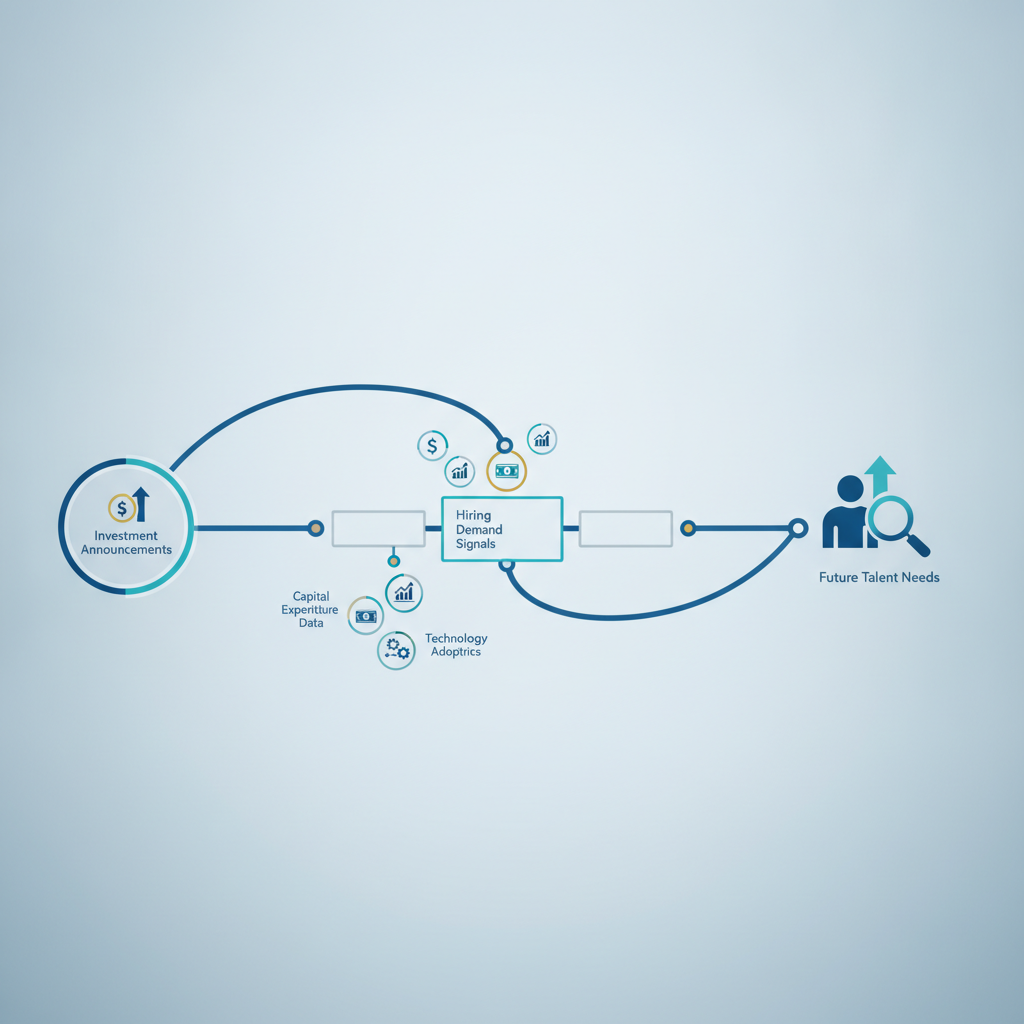
Globally, the picture is similar. Deloitte's 2026 Manufacturing Industry Outlook reports that 80% of manufacturing executives plan to invest 20% or more of their improvement budgets in smart manufacturing initiatives, and 22% plan to deploy physical AI within two years. Each of those technology investments creates a downstream need for manufacturing talent that can operate alongside the new systems. For agencies that track capital expenditure and technology adoption as hiring intent signals, these announcements are actionable intelligence, not background noise.
This is where predictive intelligence gives engineering and manufacturing recruiters a measurable edge. Platforms like Recruit Signals analyse signals such as investment announcements, technology adoption decisions, and headcount changes to surface companies entering their hiring window 20 to 30 days before roles are posted publicly. In a sector where the best manufacturing talent moves fast, that predictive window can mean the difference between winning a retained brief and losing out to a competitor who called a week earlier.
Why Slow Hiring Costs Manufacturing Clients More Than They Realise
The cautious hiring culture in manufacturing creates a specific problem that specialist recruiters are well placed to solve. According to the ONS data cited by Bespoke Career Solutions, estimated UK vacancies fell to 705,000 in February to April 2026, down 7.1% year-on-year, as employers respond to economic and geopolitical uncertainty by slowing decisions. But manufacturing output is rising at the same time. Companies are deferring headcount decisions while the work piles up.
The consequence is predictable. Skilled manufacturing talent, particularly maintenance engineers, CNC machinists, and production supervisors, does not wait. Even in a cooler market, the best candidates receive multiple approaches and move quickly. A firm that takes two extra weeks to get final sign-off on an offer will lose the shortlist. Agencies that help clients understand this dynamic, and who have the candidate relationships to prove it, are far more likely to be brought in early and given retained or exclusive terms.
Reed's analysis makes the commercial tension explicit: SMEs in engineering and manufacturing often cannot compete on salary alone, so they need to compete on speed, candidate experience, and the quality of the hire. A recruiter who frames their value around reducing hiring risk, not just filling a seat, speaks directly to what these clients fear. That framing is only credible when it comes from an agency with deep sector knowledge and a genuine pipeline of pre-vetted manufacturing talent.
Manufacturing Talent BD: How to Build the Pipeline Before Competitors Call
The practical BD challenge in manufacturing and engineering is timing. Hiring decisions in this sector are rarely spontaneous. They follow output growth, capital investment, technology rollouts, and leadership changes. Each of these events leaves a detectable trace before the vacancy is written. The same principle seen across other sectors applies here: the agency that identifies the signal earliest has the strongest position.
Regional concentration matters for prospecting. The Midlands, as highlighted in both the Senex Recruitment and Bespoke Career Solutions analyses, has recorded growth in both temporary and permanent placements, supported by strengths in advanced engineering, automotive supply chains, precision manufacturing, and specialist electronics. Agencies operating in these clusters have a natural advantage if they build their BD activity around the companies most likely to expand, not just the ones with live adverts. A Heat Score, the type of ranked company list that predictive intelligence platforms generate from multiple concurrent signals, turns that geographic focus into a prioritised outreach list rather than a cold prospect database.
Contract and temporary roles deserve more attention than most engineering agencies give them. The KPMG and REC UK Report on Jobs for January 2026, compiled by S&P Global from data from 400 recruitment companies, confirms that many manufacturers are managing uncertainty through flexible hiring rather than permanent headcount. Temporary billings have become a strategic tool for clients, not a fallback. Agencies that position their contract offering as a genuine workforce solution, rather than a consolation prize, will win business that more rigid competitors leave on the table.
Automation is also creating entirely new role categories that did not exist five years ago. According to Zoe Talent Solutions, the International Labour Organisation reports that manufacturing employs roughly 16% of the global workforce, but the composition of that workforce is shifting rapidly toward technical and data-fluent roles. Agencies that can credibly source manufacturing talent with automation, robotics, and digital manufacturing skills are in a different competitive position to those still recruiting for traditional shop-floor profiles. Building that capability, or partnering with someone who has it, is a BD decision as much as a resourcing one.
For agencies thinking about where to focus growth, the vertical BD principles that apply to scale-ups translate well to advanced manufacturing. Companies investing in new technology, expanding production capacity, or entering new markets generate a concentrated burst of hiring need across technical, operational, and leadership functions. Being the agency already in conversation when that investment is confirmed is the goal; waiting for the job posting means competing on equal terms with every other firm on the client's call list.
Frequently Asked Questions
What makes manufacturing talent harder to recruit than other sectors?
The skills gap in engineering and manufacturing is structural rather than cyclical. There is a projected shortage of over 173,000 engineers in the UK alone, and automation is continuously shifting the baseline skill requirements for existing roles. Candidates who can combine hands-on technical experience with digital systems knowledge are genuinely scarce, and they receive multiple approaches simultaneously even when the broader labour market is cooling.
How does output growth translate into manufacturing talent demand for recruiters?
When manufacturing output rises, existing teams absorb the additional workload until capacity breaks. UK manufacturing output increased 1.2% in March 2026 alone, with 10 of the 13 subsectors growing. That production pressure creates urgent hiring need, particularly for maintenance engineers, production supervisors, and technically skilled operators, often before any formal recruitment approval is in place. Agencies that track output data and capital investment announcements can contact clients during this pressure build-up rather than after the vacancy is written.
Why are contract roles becoming more strategically important in manufacturing BD?
Manufacturing companies under economic uncertainty are using temporary and contract hiring to flex capacity without committing to permanent headcount. The January 2026 KPMG and REC UK Report on Jobs, covering data from 400 recruitment companies, confirms that temporary billings have become a primary workforce management tool across engineering and manufacturing. Agencies that position contract solutions as genuine strategic options, rather than a secondary offering, win more business and build deeper client relationships than those focused purely on permanent placements.
Which geographic areas show the strongest demand for manufacturing talent in the UK?
The Midlands has consistently shown resilience, supported by advanced engineering, automotive supply chains, precision manufacturing, and specialist electronics. The West Midlands Investment Zone specifically targets advanced manufacturing, with programmes aiming to create over 30,000 jobs between 2024 and 2029. Agencies with established networks in these clusters are best placed to convert output growth and investment signals into BD conversations before competitors identify the same opportunities.
How is automation changing the type of manufacturing talent clients need?
Manufacturers are shifting from hiring manual operators toward profiles that can run, monitor, and improve automated systems. Demand is growing for technicians with sensor and predictive maintenance knowledge, engineers who can integrate AI into production workflows, and staff who can translate machine data into operational decisions. One source cites a 12% year-over-year decline in traditional open manufacturing roles as automation replaces routine tasks, concentrating demand on higher-skilled technical profiles that are harder to source through generalist channels.


