Signal SpotlightMarket IntelligenceHiring Intent Signals
Skilled Labour Shortage: BD Signals in Construction & Tech
Skilled labour shortage is driving hiring urgency in construction and tech before roles are posted. See which signals to track for a 20-30 day BD advantage.
9 min read

The skilled labour shortage is not a future problem for construction and technology recruiters. It is the defining commercial condition of 2025 and 2026, and it is actively reshaping which recruitment agencies win mandates and which arrive too late to compete. According to Deloitte's 2026 Engineering and Construction Industry Outlook, if the labour gap in the US alone persists, the industry could potentially lose nearly US$124 billion in construction output due to unfilled positions. That figure does not capture the equivalent pressure building across the UK and European markets. For recruitment agencies specialising in construction and InfoTech, the skilled labour shortage creates a specific and time-sensitive business development opportunity: the companies most exposed to that gap are also the most motivated buyers of recruitment services, often before they have posted a single role.

Why Construction's Skilled Labour Shortage Creates Predictable BD Signals
The UK construction market is valued at USD 325.33 billion in 2026 and is forecast to reach USD 391.45 billion by 2031, growing at a 3.77% CAGR, according to Mordor Intelligence's UK Construction Market report. Infrastructure is the fastest-expanding sector within that growth, projected to expand at a 7.90% CAGR to 2031. Government mega-projects, net-zero retrofit programmes, and a chronic housing shortfall are all driving pipeline simultaneously. The result is a market where demand for skilled trades and project management roles consistently outstrips the available candidate pool.
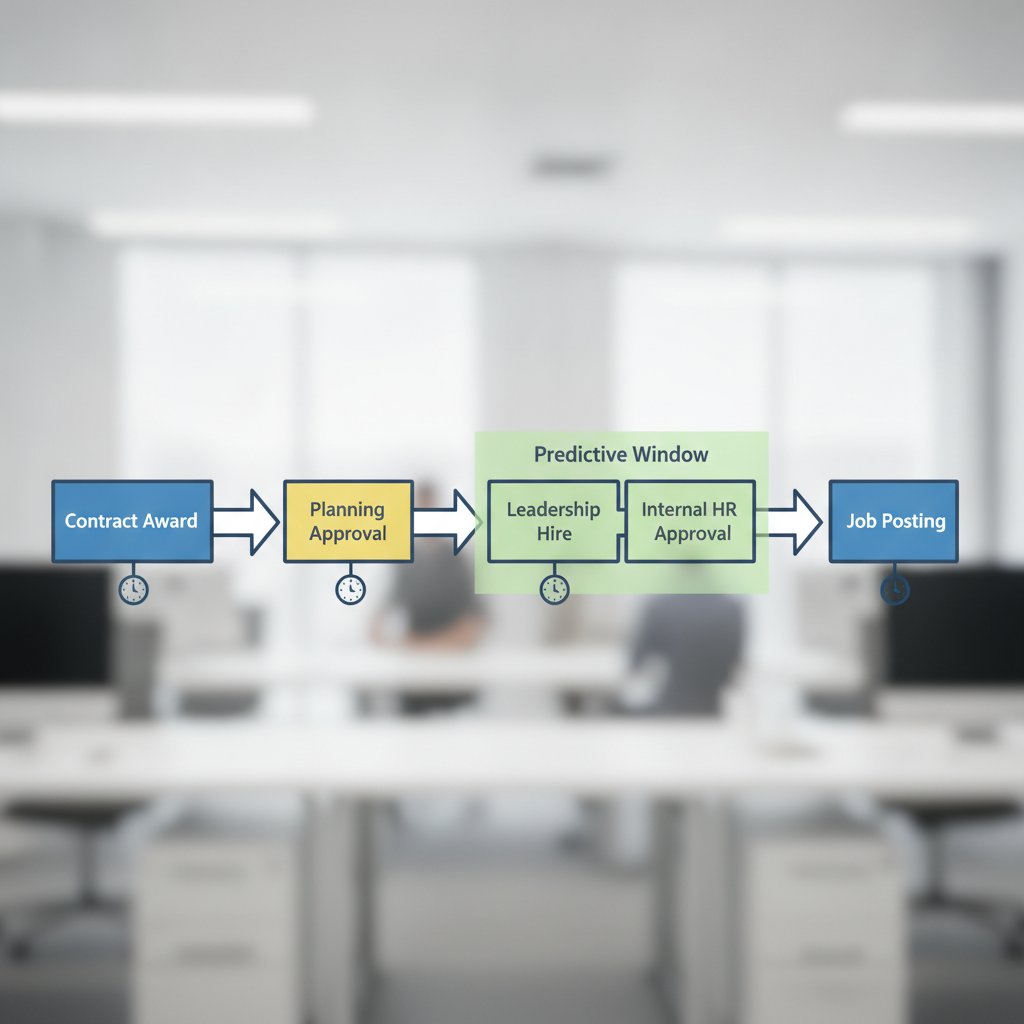
For recruitment agencies, this structural imbalance produces identifiable hiring intent signals before a role is ever advertised. When a contractor secures a rail or road package, a facilities management firm wins a public estate retrofit contract, or a modular housing developer receives planning approval, the skilled labour shortage hits immediately. Project leads, site managers, quantity surveyors, and BIM coordinators are needed on defined timescales. The company's need is real and urgent, but the job posting may not appear for another three to four weeks while HR processes the approval internally.
This gap between organisational need and public job posting is the predictive window that separates agencies running signal-based business development from those monitoring job boards. Waiting for the advert to appear costs you three weeks of competitive advantage, and in a skilled labour shortage market, that advantage is decisive. Platforms like Recruit Signals identify companies entering this window by tracking the upstream signals: contract awards, planning approvals, headcount growth velocity, and leadership hires that precede formal recruitment briefs.
InfoTech's Skilled Labour Shortage Has a Different Signal Profile
Hiring intent signals in technology follow a different pattern from construction, but the skilled labour shortage dynamic is equally acute. In San Francisco, persistent demand for office space driven by AI adoption, combined with chronic labour shortages and rising material costs, keeps the tech-adjacent construction market under continuous pressure, as noted in Turner and Townsend's Global Construction Market Intelligence 2025 report. More broadly, software and data infrastructure investment is accelerating globally, and the talent to build and maintain those systems is scarce.
The strongest predictive signal in tech recruitment is headcount growth velocity. An analysis of 1 million B2B software purchases by Bloomberry, published September 2025, found that companies with a 20% or higher increase in headcount made 38% more software purchases than those with no headcount growth. Companies that increased headcount were also 65% more likely to purchase internal knowledge base tools and 54% more likely to purchase IT help desk tools. In practical terms, a technology company expanding its headcount at pace is simultaneously buying the infrastructure to support that growth and hiring the people to operate it. Both are signals of the same underlying moment: a company in active scaling mode, experiencing the skilled labour shortage acutely, and highly receptive to a relevant recruiter's call.
A second high-value signal in InfoTech is the VP-level hire. The Bloomberry analysis found that companies that hired someone into a VP role made 28% more software purchases than companies that did not. New executives allocate budget and reset team structures in their first quarter. The skilled labour shortage means they cannot staff those structures from internal moves alone, which makes them motivated buyers of specialist recruitment services within weeks of starting. Leadership changes predict hiring 30 days before the brief appears, and that pattern holds consistently across both construction and technology verticals.

First-Mover Advantage When the Skilled Labour Shortage Is Acute
First-mover advantage in recruitment refers to the disproportionate benefit that accrues to agencies who contact hiring managers earliest, following the emergence of a new recruitment opportunity. In a skilled labour shortage market, that advantage is magnified because the candidate pool is genuinely thin. The agency that arrives first shapes the brief, sets the benchmark with its initial candidate submissions, and positions itself for an exclusive or retained arrangement before the competition is even aware the mandate exists.
According to Spacewalk's analysis of first-mover dynamics in recruitment, consistent first-contact rates above 40 to 50% across a target employer portfolio indicate effective infrastructure. Rates below 20% signal systematic late arrival. Most agencies running reactive, job-board-driven business development fall well below that threshold, because by the time a role appears publicly, two or three competitors have already been briefed.
The mechanics of first-mover advantage are particularly relevant to the skilled labour shortage context. When you contact a hiring manager before the formal brief exists, you are often the first external person to discuss the requirement with them. You can shape how they define the role, highlight the realistic candidate market given the skilled labour shortage, and surface early whether their expectations on salary or experience are achievable. Agencies arriving on day three inherit criteria already set by that first conversation. They compete on fee, not value. For a deeper look at how signal-based outreach changes these conversion dynamics, the comparison between signal-led BD and cold outreach is instructive.
How to Prioritise Your Outreach in a Skilled Labour Shortage Market
Not every hiring intent signal carries equal weight, and a skilled labour shortage market makes prioritisation more important, not less. Your BD time is finite. A five-person construction recruitment agency covering the Midlands or a ten-person tech recruiter focused on Amsterdam's scale-up corridor cannot chase every signal equally.
The highest-value signals in a skilled labour shortage environment share three characteristics. First, they are upstream of the job posting by at least 20 to 30 days, giving you a genuine predictive window. Second, they indicate organisational scale rather than isolated replacement hires, because scale creates multiple concurrent roles. Third, they are sector-specific: a funding round matters more in tech; a contract award matters more in construction; a planning approval matters in housebuilding. How hiring signals differ across IT, finance, and healthcare illustrates how signal priority changes by vertical, and the same principle applies to construction.
Hiring intent signals that meet all three criteria include: funding rounds closed in the last 30 days (particularly Series A and B, where 60 to 80% of capital typically flows into hiring according to the Execue recruitment lead signals playbook); VP-level appointments in operations or engineering functions; contract awards and planning consents made public through Companies House or sector press; and headcount growth of 20% or more over a 12-month rolling period. When multiple signals align simultaneously for the same company, the probability that active recruitment is imminent increases substantially.
Recruit Signals translates these concurrent signals into a Heat Score: a ranked list of companies most likely to need recruitment services in the next 20 to 30 days, segmented by sector and geography. For agencies covering construction or InfoTech verticals, that ranked view means BD effort concentrates on the companies where the skilled labour shortage is actively biting right now, not the ones that might hire in six months.
Frequently Asked Questions
Which specific hiring signals are most reliable for construction recruitment agencies facing a skilled labour shortage?
Contract awards, planning consents, and infrastructure project announcements are the most reliable upstream signals in construction, because they create immediate and defined labour requirements on known timescales. These signals typically precede a job posting by three to six weeks. Headcount growth velocity is a secondary signal worth tracking: a contractor growing headcount at 20% or more over a rolling 12 months is almost certainly experiencing the skilled labour shortage acutely and is receptive to a specialist recruiter's call before any role appears publicly.
How does the skilled labour shortage affect which companies are worth prioritising for BD outreach?
The skilled labour shortage makes prioritisation by sector stage more important than prioritisation by company size. A mid-market contractor that has just won a major infrastructure package faces an immediate and acute hiring need it cannot fill internally, making it a higher-priority target than a large firm with a mature internal talent function. In tech, companies that have recently closed a funding round or made a VP-level hire are the highest-priority targets, because budget has been released and team structures are being reset. Prioritise companies where multiple signals align simultaneously.
How long before a construction or tech company posts a role do hiring intent signals typically appear?
In construction, upstream signals such as contract awards and planning approvals typically precede formal job postings by three to six weeks. In technology, funding announcements and executive hires precede role postings by 20 to 30 days on average. This predictive window is the period when outreach is most effective: the need is confirmed but the company has not yet briefed competitors or posted publicly, giving the first-mover agency the opportunity to shape the brief.
Does the skilled labour shortage in construction affect salary benchmarks and placement fees?
A structural skilled labour shortage compresses the candidate pool and increases competition for specialist roles, which puts upward pressure on both contractor day rates and permanent salaries. According to Turner and Townsend's Global Construction Market Intelligence 2025, global construction cost inflation rose by 4.15% in 2024, with labour costs a primary driver in most major markets. For recruitment agencies, this environment supports higher fee percentages on specialist roles, because the value of a successful placement is demonstrably greater when the alternative is a project delay or a vacant site management position.
What is the risk of relying on job boards to identify construction and InfoTech hiring opportunities?
Job boards reflect demand that is already public, already briefed to competitors, and already constrained by a job description written without your input. According to Spacewalk's analysis, by the time most recruiters discover an opportunity on LinkedIn or a job board, multiple other agencies have already submitted candidates. In a skilled labour shortage market, where the candidate pool is thin and first-mover advantage determines who sets the benchmark, reactive job-board monitoring is a structural disadvantage, not a neutral starting point. Agencies relying on it consistently arrive late to the most valuable mandates.
Are growth signals like funding rounds reliable predictors of construction or tech hiring need?
Funding signals are a medium-strength predictor in isolation but become highly reliable when combined with sector-specific triggers. The Bloomberry analysis of 1 million purchases found that recently funded startups made 25% more software purchases in the following six months, indicating active scaling activity. In construction, funding is less relevant than contract wins, but private equity-backed contractors or PropTech companies that have recently closed a round frequently need to build both technical and operational headcount rapidly. Combined with headcount growth velocity or a VP-level hire, a funding signal becomes a strong compound indicator.


