Recruitment Marketing That Ramps New BD Billers Fast
New BD billers struggle without recruitment marketing infrastructure. Strategic prospect lists and positioning frameworks accelerate revenue generation.

Recruitment marketing is the engine that determines how quickly a new business development consultant starts generating revenue. Most agencies underestimate this. They hire a promising consultant, hand them a cold prospect list, and expect results within 90 days. When those results are slow to materialise, the assumption is that the consultant needs more coaching. More often, the real problem is that the agency has no recruitment marketing infrastructure to give a new starter genuine commercial traction from day one.
The market context makes this more pressing. According to Recruiterflow's 2026 industry analysis, the past eight quarters have forced agencies to tighten profit margins amid sustained economic uncertainty. Clients now demand more strategic involvement from agencies, not just a CV-matching service. A new BD consultant entering that environment without strong recruitment marketing support is fighting uphill before they have made a single call.

What Recruitment Marketing Actually Means for Agency BD
Recruitment marketing, in the context of agency business development, means using content, brand, data, and targeted outreach to ensure that the right prospective clients already have a positive impression of your agency before a consultant contacts them. It is not the same as employer branding or candidate attraction. The audience is hiring decision-makers, and the goal is to reduce the friction a new consultant faces when opening a conversation cold.
This distinction matters because most recruitment marketing advice conflates the two audiences. Content about candidate experience, employer branding, and EVP is aimed at companies trying to attract employees. Recruitment marketing for an agency is aimed at generating inbound credibility and outbound context for the consultants who need to win clients. The output of good recruitment marketing is a prospect who already knows your agency's name and expertise before the first call lands.
According to Allsorter's guide to BD strategies, hiring managers are pitched daily by agencies that look and sound identical. The agencies that break through are those that show up with purpose: sharing expert perspectives on hiring challenges, creating niche content that demonstrates sector knowledge, and building brand assets that reinforce credibility at every touchpoint. A case study showing a 40% reduction in time-to-hire, for example, builds trust with a hiring manager in a way that a generic agency introduction email never will.
Recruitment Marketing Gives New Starters a Running Start
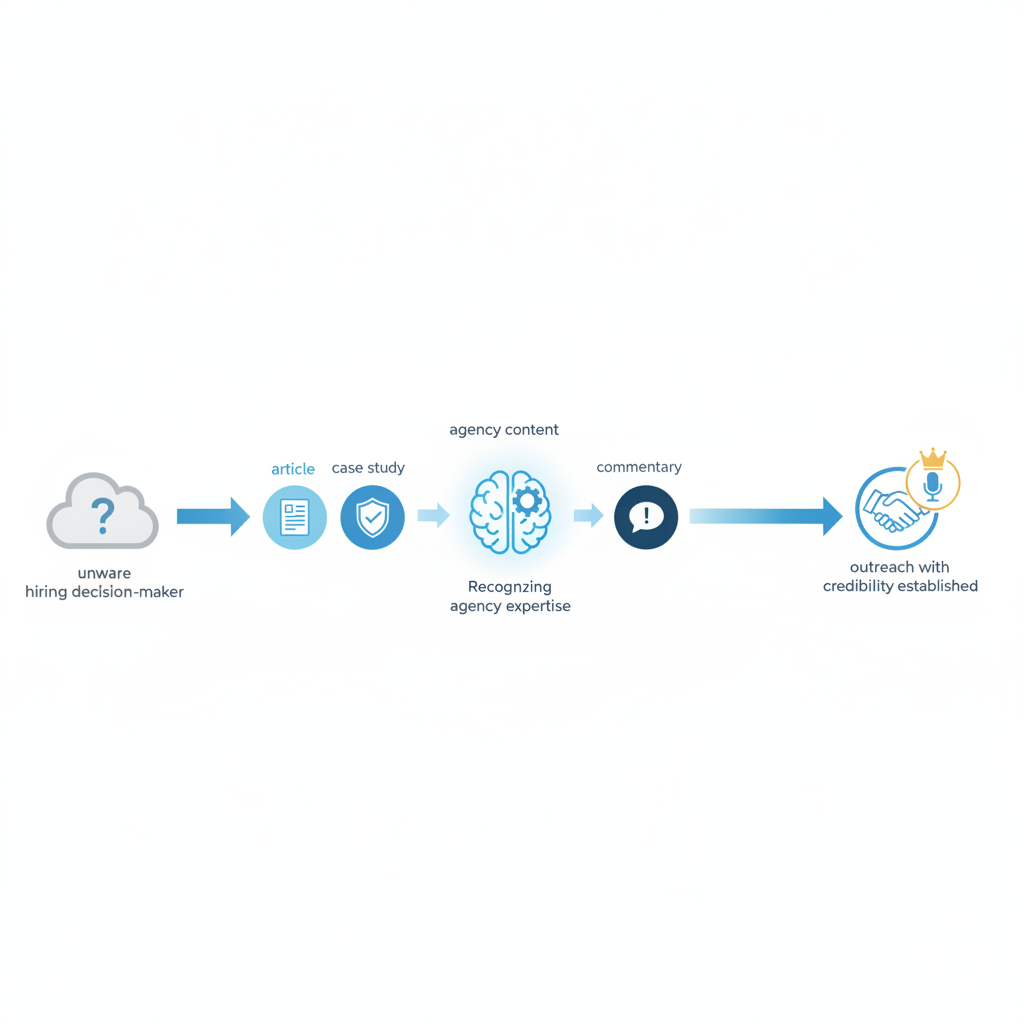
A new BD consultant without recruitment marketing support is effectively starting from zero reputation every time they dial. With it, they inherit a body of work: published articles, sector commentary, client case studies, and a LinkedIn presence that signals genuine expertise. That body of work shortens the credibility-building phase that typically consumes the first 60 to 90 days of a new consultant's tenure.
The mechanics are straightforward. Before a new consultant joins, the agency should have existing content they can immediately reference in outreach: a recent article on hiring challenges in their sector, a case study from a relevant client, a piece of commentary on a market shift that affects the prospect's hiring decisions. The consultant's first email or call cites something real and relevant rather than leading with "I'm reaching out because we specialise in..."
According to Top Echelon's analysis of BD strategies, HubSpot data shows that companies publishing 16 or more blog posts per month generate almost 3.5 times more website traffic than those posting less frequently. For a recruitment agency, the implication is that consistent content production compounds over time. Each piece a new consultant can reference is one fewer cold introduction they need to make.
The timing layer matters equally. Recruitment marketing that targets companies at the wrong moment in their hiring cycle generates low response rates regardless of content quality. Predictive intelligence platforms use hiring intent signals, which are AI-analysed market indicators such as funding announcements, leadership changes, and headcount growth, to identify companies entering their hiring window 20 to 30 days before roles are posted. When a new consultant's outreach is timed to coincide with a company's emerging need, the recruitment marketing that supports it lands in front of a receptive audience rather than one that has no current context for the conversation. Agencies using tools like Recruit Signals give new starters a prioritised prospect list with real commercial context, rather than a cold database and a target to hit.

Recruitment Marketing Channels That Actually Accelerate New Billers
Not every recruitment marketing channel produces results at the same speed. For the specific goal of ramping a new BD consultant fast, three channels consistently outperform the rest.
LinkedIn Thought Leadership
LinkedIn remains the highest-leverage recruitment marketing channel for agency BD. A consultant who publishes one substantive post per week on sector-specific hiring challenges will build a visible professional profile within three to four months. The compounding effect means that by month six, a prospect who receives an outreach message from that consultant can verify their expertise in under 30 seconds. BankW Staffing's 2026 recruitment trends analysis notes that candidates research potential employers as thoroughly as employers research candidates; the same behaviour applies to hiring managers evaluating agency partners. Authenticity and transparency in content build the trust that converts a cold contact into a warm conversation.
Niche Content and Case Studies
Sector-specific content is the strongest credibility signal a boutique agency can produce. A whitepaper on engineering hiring challenges in a post-IR35 environment, or a case study showing how a finance agency reduced time-to-fill in a competitive market, gives a new consultant a tangible asset to share before and after a first call. The content does not need to be long. It needs to be precise, current, and relevant to the specific hiring challenges of the target sector. For agencies in sectors relevant to IT, finance, and healthcare, this means content that references the hiring dynamics unique to those markets, not generic recruitment advice.
Signal-Led Outreach Sequences
Cold outreach fails primarily because it lacks context. A consultant contacting a company with no signal that the company is currently thinking about hiring is likely to be ignored, regardless of how well-written the message is. Signal-led outreach, by contrast, references something real: a recent funding round, a leadership appointment, a period of headcount growth. According to Recruiterflow's research, 63% of all placements come from existing data rather than new prospecting. Recruitment marketing that builds and maintains a warm database, with regular touchpoints timed to meaningful signals, creates the conditions for a new consultant to convert faster. The comparison between signal-based BD and cold outreach consistently favours the former on response rates and conversion speed.
Measuring Recruitment Marketing ROI for New Starters
Recruitment marketing is an investment with a measurable return, but many agencies track the wrong metrics. Website traffic and LinkedIn impressions are vanity metrics unless they correlate with meetings booked and pipeline generated. For the specific goal of ramping a new consultant, the metrics that matter are: days to first meeting booked, number of warm inbound enquiries in the first 90 days, and conversion rate from first contact to qualified conversation.
The broader data on candidate and client experience reinforces why these metrics move together. According to MSH's 2026 recruitment statistics, 75% of candidates say the hiring process affects whether they accept an offer. The same dynamic applies to client acquisition: the experience a hiring manager has of interacting with an agency's content and outreach shapes whether they agree to a meeting. Recruitment marketing that creates a positive, expert-first impression before the first conversation improves every subsequent conversion metric a new consultant faces.
Recruiterflow's data adds a further dimension: over 60% of recruiters report burnout from repetitive admin work. Recruitment marketing that generates inbound leads reduces the proportion of a new consultant's time spent on low-probability outreach. That reallocation of time, from cold prospecting to warm follow-up, is one of the most direct ways a structured recruitment marketing programme accelerates time-to-first-billing.
Frequently Asked Questions
How long does it take for recruitment marketing to produce results for a new BD consultant?
Content marketing and LinkedIn thought leadership typically take three to six months to build a meaningful audience and inbound pipeline. However, signal-led outreach, where content is paired with intelligence about which companies are actively entering a hiring window, can produce results in the first 30 days. The fastest ramps combine both: existing agency content for credibility and predictive intelligence for timing.
What is the difference between recruitment marketing and employer branding?
Employer branding targets candidates and aims to attract talent to a client organisation. Recruitment marketing, in the agency context, targets hiring decision-makers and aims to win new clients for the agency. The audience, message, and channels overlap in some areas, particularly LinkedIn, but the commercial objective is entirely different. Conflating the two is one of the most common mistakes boutique agencies make when building their BD function.
Which recruitment marketing tactics work best for specialist boutique agencies?
Niche content that addresses the specific hiring challenges of a target sector consistently outperforms generic agency marketing. A 1,000-word article on the hiring dynamics of a particular vertical, or a case study showing a measurable outcome such as a 40% reduction in time-to-hire, builds the sector authority that generalist agencies cannot replicate. Pairing this content with signal-led outreach, timed to moments when target companies show early indicators of hiring intent, produces the highest conversion rates for small BD teams.
How does predictive intelligence support recruitment marketing for new starters?
Predictive intelligence gives a new consultant commercial context they cannot generate through research alone. By identifying companies entering their hiring window 20 to 30 days before roles are posted, it allows a new starter to contact prospects at the moment they are most receptive to an agency conversation. The Heat Score, which ranks companies by their likelihood of needing recruitment services in the next 20 to 30 days, gives a new consultant a prioritised outreach list rather than an undifferentiated cold database.
How many pieces of content should a recruitment agency produce to support a new BD hire?
There is no universal number, but the principle is that a new consultant should have at least three to five pieces of sector-relevant content to reference in their first month: one case study, one opinion piece on a current hiring challenge, and one data-led article. HubSpot data referenced by Top Echelon indicates that companies publishing 16 or more blog posts per month generate 3.5 times more traffic than those posting infrequently, suggesting that sustained volume compounds returns over time. For a boutique agency, even a consistent cadence of two posts per month will outperform agencies that publish nothing.
Should recruitment marketing be set up before or after hiring a new BD consultant?
Before, wherever possible. A new consultant who joins an agency with an established content library, a recognised LinkedIn presence, and a pipeline of warm prospects warmed by signal-led outreach will reach their first placement faster than one who has to build from scratch. Treating recruitment marketing as infrastructure rather than an add-on changes the economics of onboarding new BD talent significantly.
What is the biggest mistake agencies make with recruitment marketing for BD teams?
Producing generic content that could have been written by any agency in any sector. Recruitment marketing derives its value from specificity: the more precisely content addresses the real hiring challenges of a defined target market, the more it differentiates the agency and pre-qualifies inbound interest. Agencies that publish broad advice on hiring trends, without sector depth or a clear perspective, build visibility without credibility, which is insufficient to convert a hiring manager into a client.


