How to Reactivate Dormant Clients Using Behavioural Signals
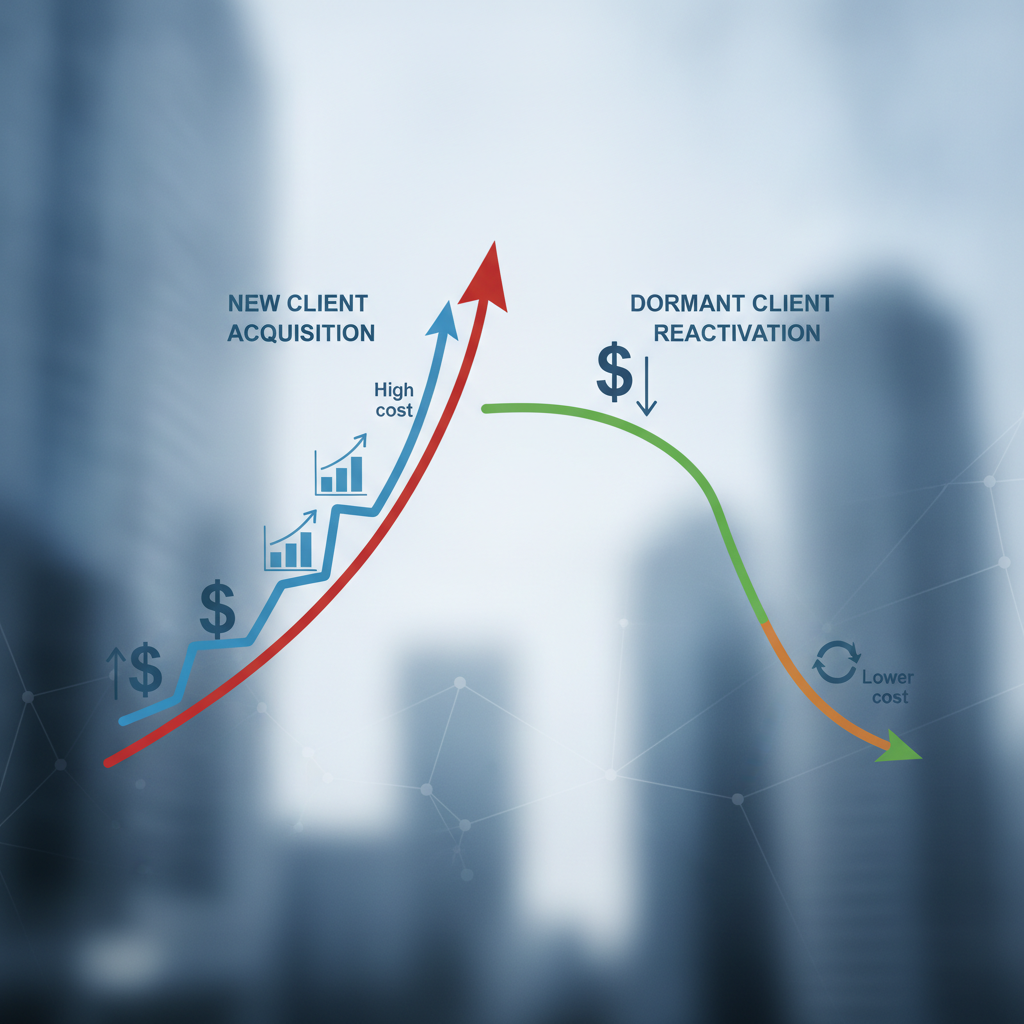
Dormant clients feel lost, yet reactivating them costs recruitment agencies five to seven times less than acquiring new ones. This is a huge opportunity!

Client reactivation is one of the highest-return activities a recruitment agency can pursue, yet most BD teams treat dormant accounts as lost causes. That assumption is expensive. Research from Lob puts the cost of reactivating a dormant customer at five to seven times less than acquiring a new one. For a boutique agency carrying 40 active requisitions and a CRM full of clients who went quiet, the maths strongly favour looking inward before chasing cold prospects.
The problem is that most agencies reactivate by guesswork: a consultant remembers a client, fires off a "just checking in" email, and hopes the timing is right. Behavioural signals change this. They tell you which dormant accounts are showing genuine signs of renewed hiring need, long before a role is posted.
Why Dormant Clients Are a Recruitment Agency's Most Underused Asset
Dormant clients are not lost clients. They are companies you already have a relationship with, who have already trusted you with a brief, and who stopped engaging for reasons that are almost always temporary. The most common causes are familiar: a hiring freeze, a change of hiring manager, a period of internal restructuring, or simply a gap in communication at the wrong moment.
The financial case for client reactivation is straightforward. According to Porch Group Media, citing Kissmetrics and Bain & Company, 65% of a company's business comes from existing customers, and a 5% increase in customer retention can increase profits by 25% to 95%. For a recruitment agency, a reactivated client skips the trust-building phase entirely. Your terms are on file. Your consultants know the culture. The sales cycle shrinks dramatically.
The challenge is identifying which dormant accounts are ready to re-engage. Without signal-led prioritisation, a consultant could spend a week calling clients who are still in a freeze, while the account that just hired a new Head of Engineering sits uncontacted. That is a client reactivation failure caused by timing, not relationship quality.
What Behavioural Signals Reveal About Dormant Client Readiness
Behavioural signals are observable changes in a company's activity that indicate renewed or imminent hiring need. Hiring intent signals refer specifically to AI-analysed market data points, including funding rounds, leadership appointments, headcount growth patterns, technology adoption, and Companies House or KvK filings, that predict future hiring before job postings appear.
For client reactivation, the most actionable signals cluster into three categories.
Leadership Changes
A new CFO, CTO, or Head of People at a dormant client is one of the strongest reactivation triggers available. New leaders restructure teams, replace departing colleagues, and bring mandates from the board to grow specific functions. Leadership changes can predict hiring need 30 days before a role is formally posted, giving a well-prepared consultant the chance to be first through the door before competitors even know the opportunity exists.
Funding and Growth Signals
A dormant client that closes a Series A, receives PE backing, or announces a new product line is not dormant in any meaningful sense. They are about to hire. The gap between the funding announcement and the first job posting is the predictive window, the 20 to 30 days during which a proactive agency can position itself before the client has even briefed their internal talent team. PE-backed companies in particular carry hiring signals that most recruitment agencies miss entirely.
Headcount and Job Posting Activity
A company that was silent for 12 months and then posts three roles on LinkedIn is telling you something. But the agency that spots the signal three weeks before those roles appear, by monitoring headcount growth patterns and LinkedIn company page activity, has a structural advantage. By the time the post goes live, your competitors are already in the conversation. You should already have a brief.

How to Build a Signal-Led Client Reactivation Process
Client reactivation without a system produces inconsistent results. A signal-led process gives your BD team a repeatable method for identifying, prioritising, and reaching dormant accounts at the right moment.
Step 1: Segment Your Dormant Client Base
Not every dormant account deserves the same attention. Start with clients who placed at least one candidate in the past three years, where you have a named contact still at the company. Then apply a recency, frequency, and value filter: how recently did they last engage, how many roles did they give you, and what was the average placement fee? This mirrors the RFM framework used in customer reactivation more broadly, and it focuses your effort on accounts with proven propensity to buy.

Zeta Global's reactivation research shows that ranking lapsed engagers by likelihood of re-engagement and contacting only the top tier produced a 22% open rate and a 1.2% click rate from previously inactive contacts. The principle translates directly to recruitment BD: outreach to your highest-propensity dormant clients first, not the entire list.
Step 2: Apply Signal Monitoring to Your Priority Accounts
Once you have your priority list, monitor those companies for the behavioural signals described above. Practically, this means setting up Google Alerts on company names, tracking LinkedIn company pages for headcount changes, and watching for Companies House filings or funding announcements via Crunchbase or Beauhurst. For agencies managing 20 or more dormant accounts, this manual process becomes a part-time job in itself.
This is where predictive intelligence platforms like Recruit Signals change the economics of client reactivation. Rather than monitoring accounts reactively, the platform surfaces which companies in your dormant list are showing concurrent hiring intent signals, ranking them by Heat Score so your BD team contacts the accounts most likely to re-engage in the next 20 to 30 days, not the ones that were most recently active.
Step 3: Craft Outreach Anchored to the Signal
Generic "we haven't spoken in a while" outreach performs poorly because it places the burden of relevance on the client. Signal-led outreach does the opposite: it opens with something specific the client will recognise as timely. "I saw you've just brought on a new VP of Engineering" or "Congratulations on the Series B" gives the client a reason to respond that has nothing to do with how long it has been since your last placement.
According to Porch Group Media, only 11% of disengaged contacts re-engage after one month of inactivity if contacted without a strong contextual hook. Signal-led outreach creates that hook by making the message feel timely rather than opportunistic.
Step 4: Sequence, Don't Spray
A single touchpoint rarely reactivates a dormant relationship. A structured sequence of three to five contacts over 30 days, across email, phone, and LinkedIn, produces materially better results than a single outreach attempt. Each touchpoint should add a new piece of relevant context: a market insight, a candidate profile relevant to the role they are likely building, or a reference to a recent company development you have tracked. This mirrors the reactivation sequencing approach that Zeta Global describes as the most effective structure for re-engaging lapsed contacts.
The Cost of Getting Client Reactivation Timing Wrong
Timing is the variable that determines whether client reactivation succeeds or fails. Contact a dormant account too early, before any signal of renewed need, and you look like a consultant chasing commission. Contact them too late, after they have already briefed a competitor, and the relationship window has closed for another cycle.
Most recruitment agencies miss this window not because they lack the relationship, but because they lack visibility. Yena's 2026 analysis of recruitment database reactivation found that time-to-fill drops by more than 40% when recruiters source from warm internal pipelines rather than cold outbound, citing SHRM talent acquisition data. The same logic applies to client pipelines: a warm dormant account that you reach at the right moment converts faster and at lower cost than a cold prospect you have never worked with.
The agencies winning on client reactivation right now are not the ones with the best relationships. They are the ones who identify the right moment to reactivate those relationships, before the client has put the brief out to the market. Signal-led BD consistently outperforms cold outreach precisely because it replaces hope-based timing with evidence-based timing.
For a 10-person agency carrying a CRM of 200 previous clients, the dormant segment almost certainly contains more near-term revenue than the cold prospect list. The practical next step is to run a signal audit: pull your dormant client list, apply the signal filters above, and rank by Heat Score or manual signal review. The accounts showing three or more concurrent signals are your reactivation priorities for the next 30 days. Start there, not with a new LinkedIn outreach campaign to companies you have never spoken to. Client reactivation, done with signal intelligence, is the most capital-efficient BD activity most recruitment agencies are not yet doing systematically.
Frequently Asked Questions
How long before a recruitment agency should classify a client as dormant?
There is no universal threshold, but a reasonable benchmark for recruitment agencies is a client with no active brief and no meaningful contact in 12 months or more. Agencies working in fast-moving sectors like technology may apply a shorter window of six to nine months. The more relevant question is not how long the client has been silent, but whether they are now showing signals of renewed hiring need, which can happen regardless of how long they have been dormant.
What are the most reliable behavioural signals for recruitment agency client reactivation?
The three strongest signals are leadership changes (particularly at C-suite or Head-of-function level), funding events (seed, Series A, Series B, or PE investment), and headcount growth on LinkedIn or company career pages. These signals indicate structural change at the company, which almost always produces hiring need within 20 to 30 days. A combination of two or more concurrent signals makes a dormant account a high-priority reactivation target.
Why do dormant clients re-engage more readily than cold prospects?
Dormant clients already know your agency, have previously trusted you with a brief, and have terms agreed. The trust-building phase of the sales cycle is complete. This means your outreach carries context that cold prospects simply do not have, making the conversation warmer and the conversion faster. According to research cited by Porch Group Media, 65% of a company's business comes from existing customers, which reflects this dynamic across industries.
How many touchpoints does client reactivation typically require?
A structured sequence of three to five touchpoints over a 30-day window is more effective than a single outreach attempt. Each contact should add new information: a relevant market insight, a candidate profile, or a reference to a company development you have observed. This sequenced approach works because it demonstrates active knowledge of the client's situation rather than a generic check-in.
What is the difference between client reactivation and standard BD outreach?
Standard BD outreach targets companies you have never worked with, requiring you to build credibility from scratch. Client reactivation targets companies you have already placed with, where the relationship, process knowledge, and agreed terms already exist. The primary task in client reactivation is timing: identifying when a dormant account has returned to a hiring posture, not convincing them to use a recruitment agency for the first time.
Should client reactivation be a dedicated activity or part of general BD?
Client reactivation produces better results when treated as a distinct, signal-monitored programme rather than folded into general BD. This is because the triggers, signals, and outreach approach differ from cold prospecting. A dedicated reactivation list, monitored for hiring intent signals and worked through a structured outreach sequence, prevents dormant accounts from being deprioritised in favour of new logo pursuit, which is the most common reason reactivation opportunities are missed.


