Hiring Signals Tools: Which Ones Win Clients
Best prospecting tools for recruiters: hiring signals that predict recruitment needs through funding rounds, leadership changes, and job posting spikes.

Hiring signals are the market events that predict a company's imminent recruitment need: a funding round, a leadership appointment, a sudden spike in job posting velocity. If you are spending hours researching prospects who turn out not to be hiring, you are not alone. The OneUp Sales Future of BD report found that BD calls across the recruitment sector fell 10.4% in the period between September 2024 and August 2025, yet the agencies that held their ground were the ones who made better-qualified contacts, not more of them. That shift from volume to value is precisely where hiring signals tools separate the agencies winning clients from those burning time.
The core argument is simple: the right tool surfaces companies entering their hiring window before they post roles. Get there first and you are having a commercial conversation. Get there after the job board alert fires and you are queuing behind every other agency in your patch.

What Hiring Signals Tools Actually Do
Hiring signals tools identify companies likely to recruit before they advertise, by monitoring market events that correlate with imminent hiring need. These events, known as hiring intent signals, include funding announcements, executive leadership changes, technology licence purchases, headcount growth trends, and shifts in job posting velocity. A tool that tracks these signals gives your BD team a reason to call that is grounded in what is happening inside the prospect's business right now.
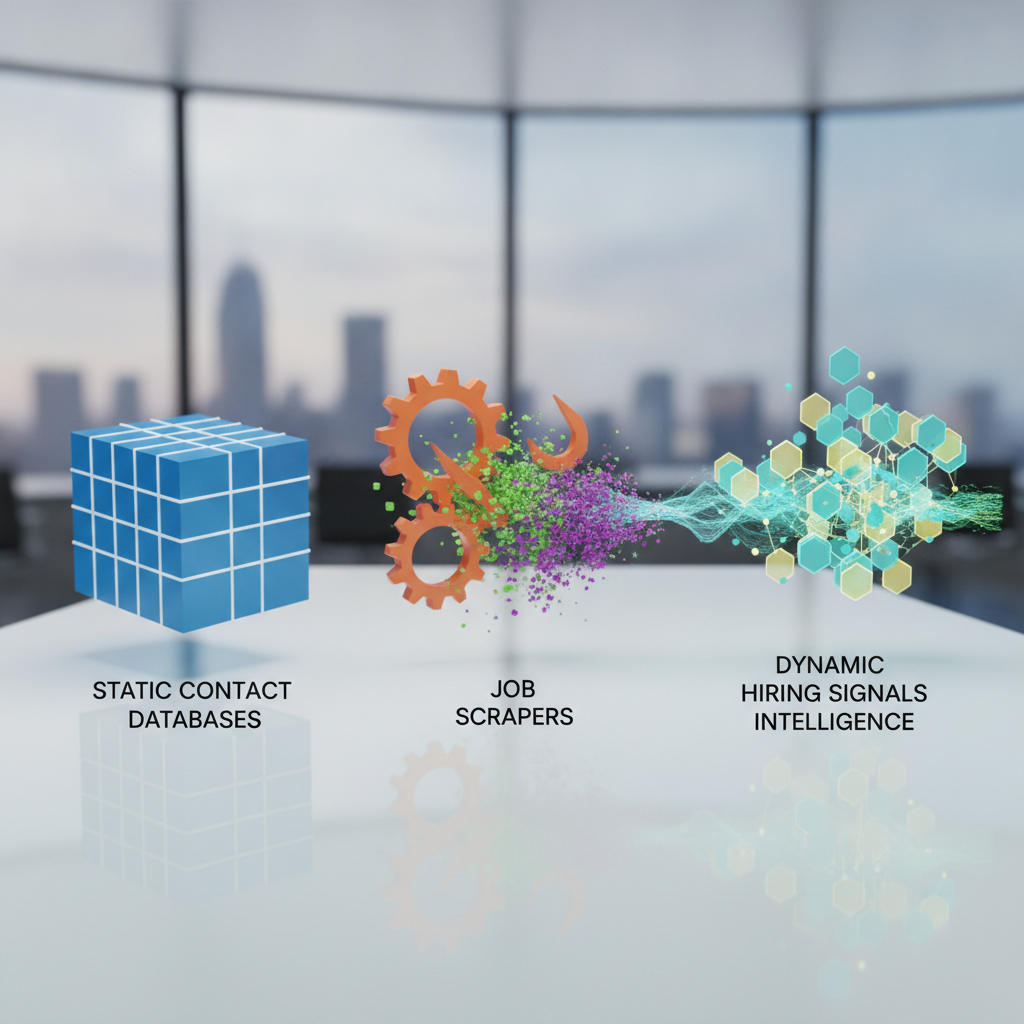
That is fundamentally different from a contact database, a job board scraper, or a CRM enrichment tool. Contact databases tell you who exists. Job board scrapers tell you who is already advertising. Hiring signals tools tell you who is about to need you, before the brief is written. The distinction matters enormously in a market where, as the Bullhorn GRID 2025 Industry Trends Report, which surveyed more than 1,500 recruitment professionals globally, notes, attracting new clients is the number one priority for agencies heading into 2025, with 77% focused on increasing market share.
The question most agency owners ask at this point is: which category of tool delivers genuine first-mover advantage, and which just repackages information you could find yourself? The answer depends on when in the hiring cycle the tool surfaces the signal.

Hiring Signals Sources: Where the Data Comes From
The quality of a hiring signals tool is determined by what it monitors and how far in advance of a live vacancy it alerts you. There are several distinct data layers, and they carry different lead times.
Job posting data is the most common and the least valuable for proactive BD. By the time a role is posted, the client has already written a brief, possibly briefed other agencies, and started receiving speculative calls. Acting on job postings alone typically costs you a three-week head start. Tools that monitor live vacancies are useful for understanding hiring patterns in hindsight but weak for winning the first conversation.
Funding data is a stronger signal. Companies that close a Series A, Series B, or growth equity round almost always expand headcount in the months that follow, particularly in commercial, technical, and leadership functions. A tool that surfaces a funding round the day it closes gives you a window of roughly three to four weeks before the resulting roles appear publicly. That window is where the brief is won.
Leadership changes carry a similar lead time and are often overlooked. A new Chief Revenue Officer almost always rebuilds the sales function. A new CFO frequently restructures the finance team. Leadership appointments predict hiring 30 days before most roles are posted, making them one of the most reliable hiring signals available. Platforms that combine funding, leadership, and job posting velocity into a single ranked output give BD teams a prioritised prospect list rather than a pile of raw data to interpret.
Hiring Signals Tools vs CRM Enrichment and Contact Databases
Many agencies conflate hiring signals tools with the data enrichment tools they already use inside their CRM. They are not the same category. A CRM enrichment tool updates contact records with current titles, emails, and company information. It tells you that the person you knew at a company is still there. It does not tell you whether that company is about to hire.
The practical difference shows up in outreach quality. When a consultant calls a prospect armed with a fresh hiring signal, the conversation has a reason to exist: "I saw you closed your Series B last week and I work exclusively with scale-ups building out their engineering team." When a consultant calls from an enriched contact record alone, the conversation starts cold regardless of how accurate the data is.
The OneUp Sales State of Recruitment 2025 report, drawing on data from 300-plus agencies and thousands of consultants globally, makes the same point from a different angle: completed meetings per 1,000 BD calls rose from 58.2 to 62.6 across the sector despite fewer dials being made. Agencies that improved meeting efficiency did so by targeting better, not calling harder. Hiring signals are what makes targeting better possible.
The same logic applies to job board monitoring services. Tracking which companies are advertising is useful for understanding a market, but it is not a prospecting tool in any predictive sense. The gap between a hiring signal and a live job posting can reach 20 to 30 days, and that gap is where first-mover advantage lives.
How Agencies Should Choose Between Hiring Signals Tools
What criteria distinguish a hiring signals tool that changes your BD results from one that adds noise? Three questions cut through most of the market quickly.
First: does the tool surface signals before the job posting, or after? If the primary data source is live vacancies, it is a job board aggregator, not a predictive tool. Ask the vendor what their typical lead time is between signal detection and the first public vacancy from the same company.
Second: does the tool rank prospects by urgency, or just list them? A list of companies that raised funding this month is marginally useful. A ranked list that weights multiple concurrent signals, funding plus leadership change plus headcount growth, so you know which companies are most likely to need recruitment services in the next 20 to 30 days, is a BD tool. Platforms like Recruit Signals translate multiple concurrent hiring intent signals into a Heat Score, a ranked output showing which companies in your patch are entering their hiring window, so your team starts each week with a prioritised call list rather than a cold database.
Third: is the signal data specific to your sector and geography? A tech recruitment agency in Amsterdam does not need a global signal feed covering every industry. The best hiring signals tools let you filter by sector, company size, funding stage, and location so your BD team is seeing the prospects that are genuinely in their patch. The Bullhorn GRID 2025 report noted that top-performing agencies were 57% more likely to be in the advanced stages of digital transformation than those that saw revenue decline, and smarter prospect targeting is one of the clearest expressions of that maturity.
The JobAdder Recruitment Growth Reset makes a point that applies directly here: it takes an average of four to ten new-business opportunities to win one new client. If hiring signals tools narrow that funnel by ensuring the opportunities you pursue are companies genuinely entering a hiring window, the commercial impact on conversion rates is significant even before you consider the time saved on research.
Making Hiring Signals Part of Your BD Workflow
A hiring signals tool is only as useful as the workflow it plugs into. The agencies seeing the clearest results from predictive intelligence are those that have made signals the starting point of their BD week, not an afterthought layered on top of an existing cold-call rota. The signal fires, the consultant checks the company's context, crafts a specific opening line, and calls within 48 hours. That sequence turns a data point into a warm conversation.
The OneUp Sales Future of BD report captures the market shift precisely: client access is no longer the prize in itself. What matters is whether the meeting produces qualified, deliverable work. Hiring signals give you the context to walk into every meeting with a credible reason to be there, specific to what is happening in that company's business right now.
Recruit Signals is built around this workflow, surfacing companies likely to hire 20 to 30 days before roles appear, ranked by the strength of concurrent hiring signals, so recruitment agencies can focus BD time on the prospects most likely to convert rather than spreading effort across a cold universe of names.
Frequently Asked Questions
What are the best prospecting tools for recruiters who want to win clients before job postings appear?
The most effective prospecting tools for recruitment agencies are those that monitor hiring intent signals, such as funding rounds, leadership appointments, and job posting velocity, rather than live vacancy feeds. These signals typically precede public job postings by 20 to 30 days, giving agencies a window to contact prospects before competitors know the opportunity exists. Predictive intelligence platforms that rank prospects by signal strength give BD teams a prioritised outreach list rather than a cold database.
How do hiring signals differ from job board monitoring for agency BD?
Job board monitoring surfaces roles that are already live, meaning the client has already written a brief and may have briefed other agencies. Hiring signals, by contrast, identify companies entering a recruitment need before any vacancy is posted, using market events such as funding announcements, executive hires, and headcount growth as predictors. The practical difference is a lead time of up to 20 to 30 days, which is where first-mover advantage is won or lost.
Which hiring signals are the most reliable predictors of imminent recruitment need?
Funding rounds, particularly Series A and Series B announcements, are among the strongest single signals because growth capital almost always drives headcount expansion in commercial, technical, and leadership functions. Leadership changes carry comparable lead times: a new executive in a revenue or operations role typically triggers team restructuring within weeks. The most reliable signal comes from combining multiple concurrent data points, funding, leadership change, and job posting velocity together, rather than acting on any single event in isolation.
How should a small recruitment agency with limited BD resource use hiring signals tools?
Small agencies benefit most from tools that rank prospects by signal strength rather than delivering raw data lists, because ranking eliminates the research burden of deciding who to call first. With a small team, the goal is to concentrate every BD hour on companies genuinely entering their hiring window. Filtering by sector, geography, and company size ensures the signal feed reflects the agency's actual patch rather than creating more noise to sort through.
Do hiring signals tools replace CRM enrichment or contact databases?
No: they serve a different function. Contact databases and CRM enrichment tools keep your records accurate and tell you who works where. Hiring signals tools tell you when to call and why, by identifying companies whose circumstances suggest imminent hiring need. The most effective BD stacks combine accurate contact data with predictive signals so consultants know both who to reach and what to say when they do.


